
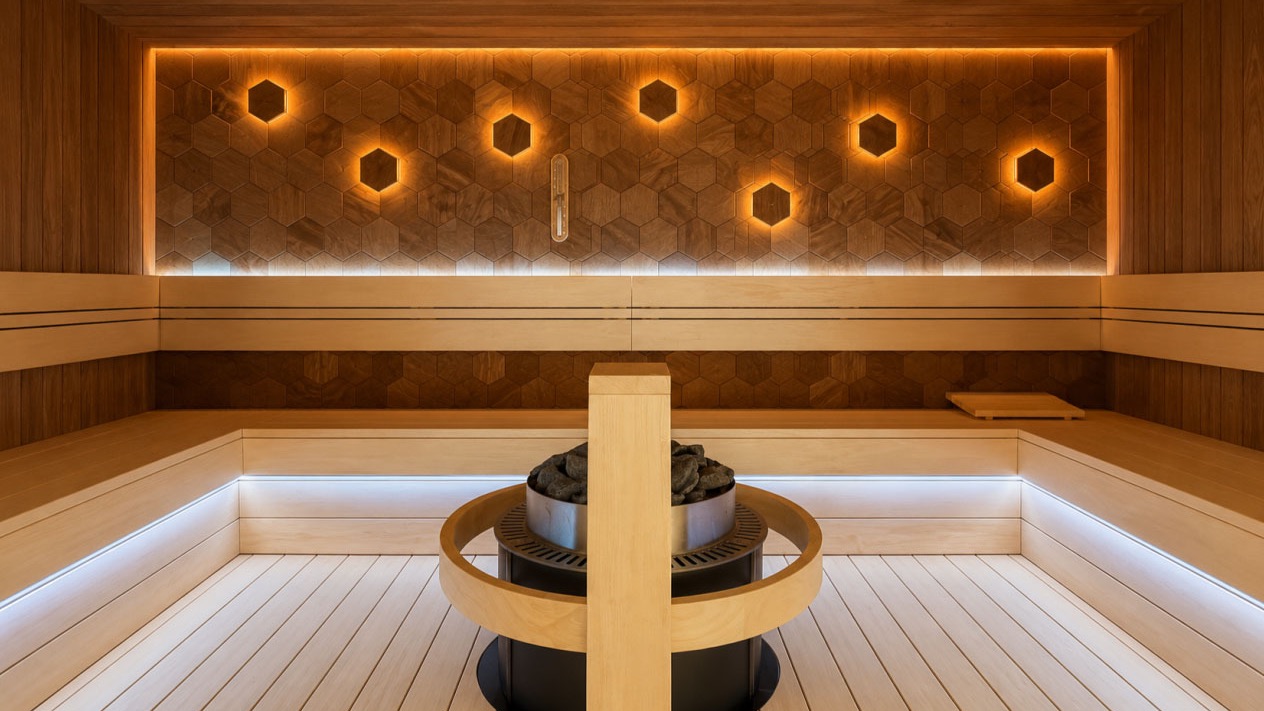
This article first appeared on the author’s LinkedIn page (LinkedIn Pulse) on 31 August 2026, in Hungarian: A szaunatűz nem a szaunában ér véget.
Saunas are demonstrably healthy, as they stimulate circulation, strengthen the immune system and reduce stress. Many people enjoy the habit, and rightly so. At the same time, the habit of sauna bathing has a fire safety side that is worth keeping in mind, so that this form of recreation and relaxation does not become a nightmare for the owners.
If you had to remember two things about the fire safety of saunas, one would certainly be the safety clearance for installing the sauna heater, and the other that in case of a fire or an event pointing to a fire, the fire service must be alerted immediately, without delay.
For one particular sauna heater the manufacturer specified a safety clearance of 12 centimetres between the heater and the combustible wooden lining. In many sauna fires, in Hungary and abroad, this one parameter was not observed, and the sauna fire was the result. In another case a long time passed between the fire signal and the notification of the fire service, which significantly escalated the initial sauna fire. By then the fire had reached the mechanical space above the suspended ceiling, and then the roof structure as well.
Sound familiar?
Together, the two circumstances show that, unfortunately, no single good decision solves the fire safety of a sauna. A hotel, swimming pool or wellness-centre sauna is best treated as a stand-alone technological unit with a high local fire risk, because that is what it is. However misleading it may be that the surroundings are generally wet and damp, which leads to the false conclusion that the installation is therefore also “fire-safe”.
The sauna as a fire safety environment to be assessed on its own
At first glance a sauna is a simple room. Wooden wall lining, benches, a heater and some electrical equipment. Few spaces in a building concentrate so many risk factors in such a small floor area.
A few square metres combine:
- a high-power, continuously operating, high-temperature heat source;
- a large area of combustible wood lining and wooden benches next to the heat source;
- high-power electrical energy in a hot, humid environment with strong temperature swings;
- intensive, often unsupervised communal use;
- hidden space behind the lining and above the suspended ceiling, where a fire can develop unnoticed for a long time.
This coincidence of factors explains why a sauna fire rarely stays within the boundaries of the sauna.
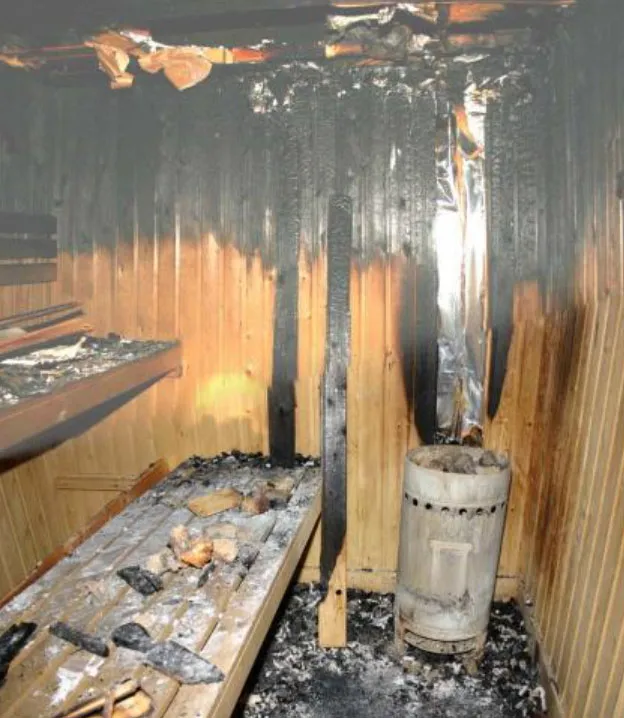
Burnt-out sauna (burgoynes.com)
When looking at sauna safety internationally, it is natural to look towards Finland first, as we all know how deep the sauna culture runs there. The Finnish data show that sauna fires are not isolated events. According to the statistics of the Finnish safety authority Tukes, roughly 90-150 fires a year in recent years started in the vicinity of electric sauna heaters. In 2024 about one hundred were recorded. The authority repeatedly names the same causes. These are clothes dried in the sauna, an object left on or near the heater, accidental switch-on, and failure of the heating element, the thermostat or the timer.
The Finnish figures cannot be transferred directly to Hungary, because the density of saunas here is smaller by orders of magnitude. The failure mechanisms, however, are the same, and in my view so are the lessons.
Experience from Hungarian fire investigations
A case series presented by Sándor Farkas at a fire investigation conference in 2022 covers several sauna fires in hotels, guesthouses, swimming pools and sports-wellness facilities in Hungary. The material is an expert collection of cases, not a statistical sample, so no percentage breakdown of causes can be derived from it.
The value of the case series is that it shows recurring, interrelated failure patterns. These are the following:
- breach of the manufacturer’s safety clearance between the heater and the wooden lining, in one of the cases presented there by omitting the prescribed 12-centimetre side clearance;
- use of cabling with inadequate heat resistance;
- an electrical fire at a control unit built into a wooden structure;
- ignition at the luminaire of the sauna or at its connection;
- missing direct fire detection, because there was no detector in the sauna or in the room enclosing it, only in the corridor further away;
- late alerting of the fire service, up to 20 minutes after the first signal.
Two cases are instructive in their own right.
At one swimming pool, the fire investigation found clearly visible charring next to the heater in another, still operating sauna of the facility. No fire had started there yet. The mechanism, however, was already working in the background, and it was already visible.
The other is a hotel sauna that caught fire twice. After the first fire a heat-sensing cable was installed, which detected the second fire early. Yet the fire service was called only 21 minutes later, so the technical protection ended up achieving nothing, because the late intervention led to a large-scale loss event.
The cause of ignition and the factor aggravating the consequence must be treated separately. The lack of a safety clearance between the sauna heater and the lining, an incorrectly chosen electric cable, or a faulty control can cause a fire. The lack of automatic fire detection, a fire service alert made with a delay of twenty minutes, and inadequate protection against fire spread around the sauna can turn an initial fire into a building-scale event. Different types of failure can be defended against with different means.
The role of maintenance, based on a Finnish investigation
On 8 October 2023 in Vantaa, in the Hakunila district, five people died in a residential fire: a mother and her four young children. According to the report published in July 2025 by the Finnish accident investigation authority, OTKES, the sauna heater had been switched on by an accidental timer setting. The heater switched on during the night, and the wall panel behind it caught fire.
The investigation, however, also uncovered deeper causes. The heater stones had not been replaced for years, and the stones had settled, wedged together and crumbled, which restricted the airflow out of the stone compartment. As a result the heater could overheat abnormally, and the heat was carried towards the structure instead of into the sauna room. According to the report, the heater stones should typically be replaced every year so that air can flow through the heater properly (!). In my view not many people here are aware of this.
The design of the control interface also contributed to the event. The device had no child lock, and it did not clearly indicate the switched-on or timed state.
As a designer, I think two conclusions are worth drawing. Heater stones can be regarded as a fire safety component, as their condition directly affects the heat output of the heater. And accidental switch-on is a real risk, so a clear indication of the switched-on state is a safety function. In home installations it is advisable to completely de-energise the circuits of saunas that are not in use.
Wood lining can ignite under prolonged heat exposure
The wood lining of saunas is regularly and continuously exposed to high heat loads. In this situation what matters in itself is not whether the wood reaches the short-term laboratory ignition temperature at a given moment.
Heat exposure over a long period dries out the wood and breaks it down thermally. A visible sign of this is discolouration, browning, blackening, that is, surface charring. According to the fire safety literature, under prolonged heat exposure wood reaches self-heating, smouldering and then ignition at a lower ambient temperature than under short-term heating.
For exactly this reason we should not use the textbook values of around 200-300 °C as an operating threshold of “safe below this”. Spontaneous ignition depends on the wood species, the dimensions, the heat load and its course over time.
Discolouration or charring next to the heater is a fire safety warning. It should be investigated immediately. In such a case it is advisable to change the position of the sauna heater at once and increase the safety clearance.
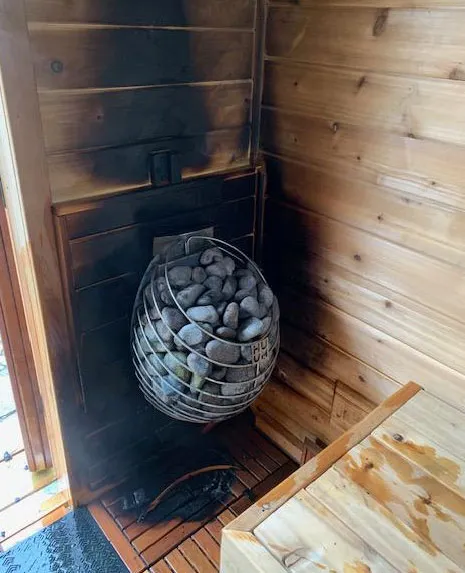
clearly visible charring, inadequate safety clearance
Seven rules for preventing sauna fires
1. The manufacturer’s safety clearance
The safety clearance between the heater and combustible (wooden) structures must be determined from the manufacturer’s documentation for the given heater type.
For one heater in the Hungarian case series, the manufacturer prescribed a 12-centimetre side clearance, and it was not observed. However, 12 centimetres is not a general sauna rule. The data sheets of heaters on the market list clearances of 50, 100 or 200 millimetres, depending on model and output. The clearances at the side, at the front, towards the ceiling and towards the bench are not necessarily the same.
The correct engineering position is the following. The heater may be installed only at the clearances and with the structural arrangement given in the valid manufacturer’s instructions for the specific type.
The manufacturer’s clearance cannot be reduced afterwards with a sheet screwed on or an unproven protective lining. When a heater is replaced, the whole sauna arrangement must be checked again, because the clearances of the old heater are not inherited. For existing saunas, the manufacturer’s data must be compared with the actual installation. A good and safe arrangement can be one where no combustible sauna lining or bench is placed within half a metre of the heater.
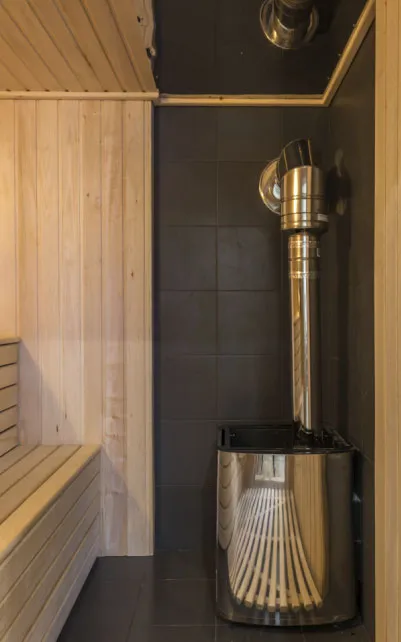
A simple, good solution: non-combustible lining around the heater (isauna.ca)
2. The electrical equipment of the sauna
The location-specific standard, MSZ HD 60364-7-703, sets the requirements for the electrical installation of saunas. The standard divides the sauna into zones with different heat loads:
- in the immediate vicinity of the heater, only electrical equipment belonging to the heater may be installed;
- in the highest, hottest space, electrical equipment must have a heat resistance of at least 125 °C, and the insulation of the cables at least 170 °C;
- there is a separate requirement for protection against water ingress, typically at least IP24, and at least IPX5 where water-jet cleaning is used;
- cables should preferably be run on the cold side of the thermal insulation, and on the hot side only with cabling of suitable heat resistance.
The requirement applies to luminaires and LED systems, cables and joints, the thermostat and the temperature sensor, the control unit, and junction and connection boxes.
A luminaire designed for a humid room cannot necessarily withstand the temperature under the sauna ceiling for long. The same is true for cables and fittings. The Hungarian case series is precisely about this, as the fires started at a cable that was not heat-resistant, at a control built into a wooden structure, and at a luminaire.
The control and the joints should, where possible, be located outside the sauna room. The electrical installation should be designed, built and checked by a person authorised to do so.
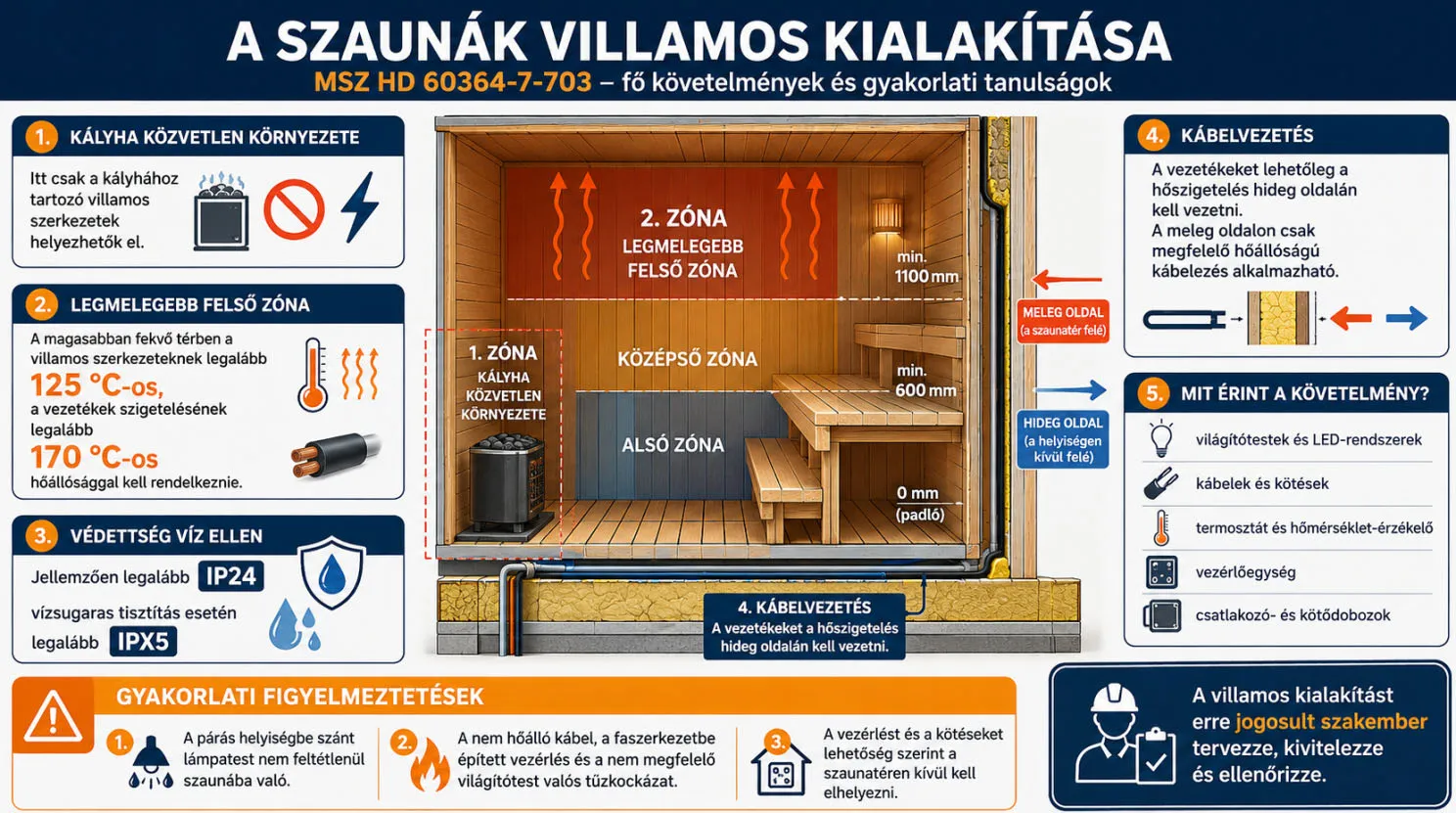
Safe electrical installation (AI graphic)
3. Maintenance of the heater stones
Besides storing heat, the job of the heater stones is to let air flow through the stone compartment so that heat is carried into the sauna room. Stones that have settled, wedged together or crumbled obstruct the airflow. The heater overheats, and the heat starts to move towards the structure.
The stones must be rearranged and replaced at the frequency given in the manufacturer’s instructions. In communal use with daily sessions of many hours, adopting the domestic interval is not enough. In such a case a maintenance plan tied to operating hours or condition is justified. The Vantaa case shows that this seemingly minor maintenance item can have deadly consequences.
4. Keeping the heater surroundings clean
According to international fire statistics, one of the most common hazardous situations is when a towel, swimsuit, slippers, plastic bucket, bottle of cleaning agent, mop or decoration ends up on the heater or near it. The sauna must not be used for storage or for drying clothes, even outside operating hours.
Ignition does not require deliberate switch-on. It is enough for the switch to be operated by accident, a faulty timer, a remote start, carelessness after cleaning or maintenance, or an object left there by a guest.
A check before use is therefore a substantial safety task. Before switching on, it must be physically verified that there is nothing on the heater, on the guard rail, or in dangerous proximity to them. This is the cheapest error group on the list to eliminate.
5. Conditions for remote start
A sauna heater that can be started from a mobile phone or a building management system is a convenient solution, but it also creates a new hazard. The person switching it on cannot see the current state of the sauna.
The IEC 60335-2-53 product standard for sauna heaters therefore deals with the safety of remote operation and with electronic interlocks. The scope of the standard also extends to communal saunas in apartment buildings, hotels and similar places. In modern systems a door sensor or a safety device placed on the heater prevents remote starting if the safe state is not verified. The solution must be provided by a jointly certified system of heater and control.
A technical interlock does not replace checking the room. In a communal sauna the start should preferably be a process tied to staff, with a mandatory on-site inspection immediately before starting.
6. Maintenance and electrical inspection
The sauna heater, the thermostat, the timer, the control, the lighting and the electrical joints are subject to heavy wear because of the high temperature and the temperature swings.
The following phenomena call for immediate investigation, and mean that the sauna must be taken out of operation:
- discoloured or charring wood around the heater;
- melted, brittle or discoloured cable and cable sheath;
- an unreliably working thermostat or timer;
- flickering lighting;
- abnormal humming, crackling or a burning smell;
- an overheating switch or control unit;
- damaged, crumbling or settled heater stones;
- a deformed heater body and a loosened lining.
The legal framework is also in place. According to the Electrical Safety Code, an electrical safety inspection of the low-voltage electrical installations of buildings classed as workplaces, such as hotels, swimming pools and wellness centres, must be carried out at least every three years. For residential buildings this period is six years.
The three-year cycle is the legal minimum. For a sauna heater operating for several hours a day, more frequent checking is necessary. For intensive use, introducing an annual targeted sauna electrical inspection as an internal maintenance requirement is recommended. This is a risk-based professional recommendation, not a legal requirement, but the Hungarian case series shows exactly where the fires start.
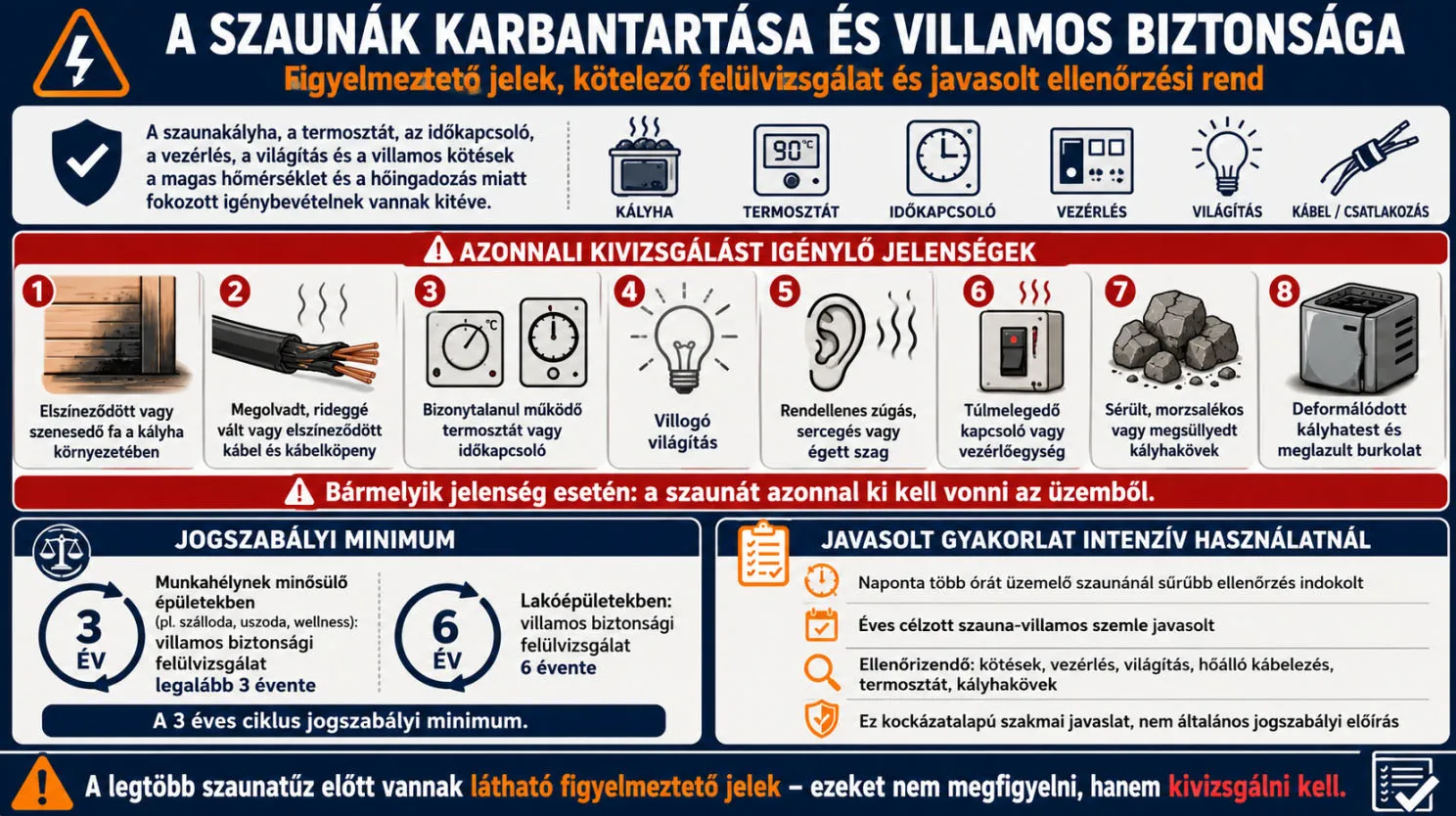
Maintenance and electrical safety (AI graphic)
7. Designing early fire detection
Traditional detection solutions cannot be applied to a sauna automatically in the same way as in an average hotel room or corridor, because of the sauna’s high base temperature and humidity load. It does not follow, however, that the sauna can be left out of detection.
The Hungarian case studies include several fires where there was no detector in the sauna, only in the corridor further away. By the time the detector placed there signalled, a fire had already spread widely. The Fire Safety Technical Guideline on installed fire alarm systems expects the automatic supervision of every room under full-coverage protection. The list of low-risk exceptions includes the bathroom, the shower, the washroom and the WC, but not the sauna. Automatically leaving out the sauna as a wet room therefore cannot be justified professionally.
The lesson is twofold:
- For the sauna, a detection method suited to the ambient temperature and properly designed must be chosen. The maximum operating temperature of the detector, its alarm characteristic and the manufacturer’s installation limits must be compared, with documentation, against the heat profile of the sauna.
- The acceptance of a signal must be followed by an immediate and unambiguous intervention procedure.
A high-setpoint heat detector can be placed inside the sauna. Even where there is no detector inside, it is important that suitable protection is built into the sauna room, and possibly into the hidden space above it, which ensures that the operation of the sauna is also acceptable from the fire alarm point of view.
Limiting fire spread in communal saunas
In a hotel, swimming pool or wellness centre, assessing how to avoid ignition is not enough in itself. What happens afterwards must also be examined.
In the Hungarian cases the fire usually spread to the mechanical space above the suspended ceiling, and then to the roof structure. This makes it justified to examine:
- the fire-resisting separation between the sauna and the surrounding spaces;
- the fire-resisting sealing of wall and floor penetrations;
- the interruption of fire-spread paths behind the lining and above the suspended ceiling;
- the quick and unambiguous identification of the location of the alarm;
- the possibility of risk-proportionate automatic or manual extinguishing.
If the sauna is located within a more or less fire-resisting box, the chance of a sauna fire escalating to the level of the building is much smaller.
The question of extinguishing is also worth dealing with. A pre-action sprinkler working at high temperature may be considered, as may an open-nozzle system with manual start in a permanently supervised place. These are, however, generally “only” professional recommendations, because not every sauna is subject to a general obligation to install an extinguishing system. For a busy wellness facility, a sauna in close contact with the roof space, and a high business-interruption risk, examining them is justified.
According to full-scale water-mist experiments in 2022, a system designed for a sauna fire scenario can control and suppress the fire. The tests, however, also showed smouldering and, under unfavourable conditions, re-ignition. Effectiveness was strongly influenced by early activation, the placement of the nozzles and ventilation. There is therefore no universal solution to be picked from a catalogue here either. The temperature rating of the sprinkler head and the whole extinguishing system must be designed on the basis of the normal operating temperature of the sauna.
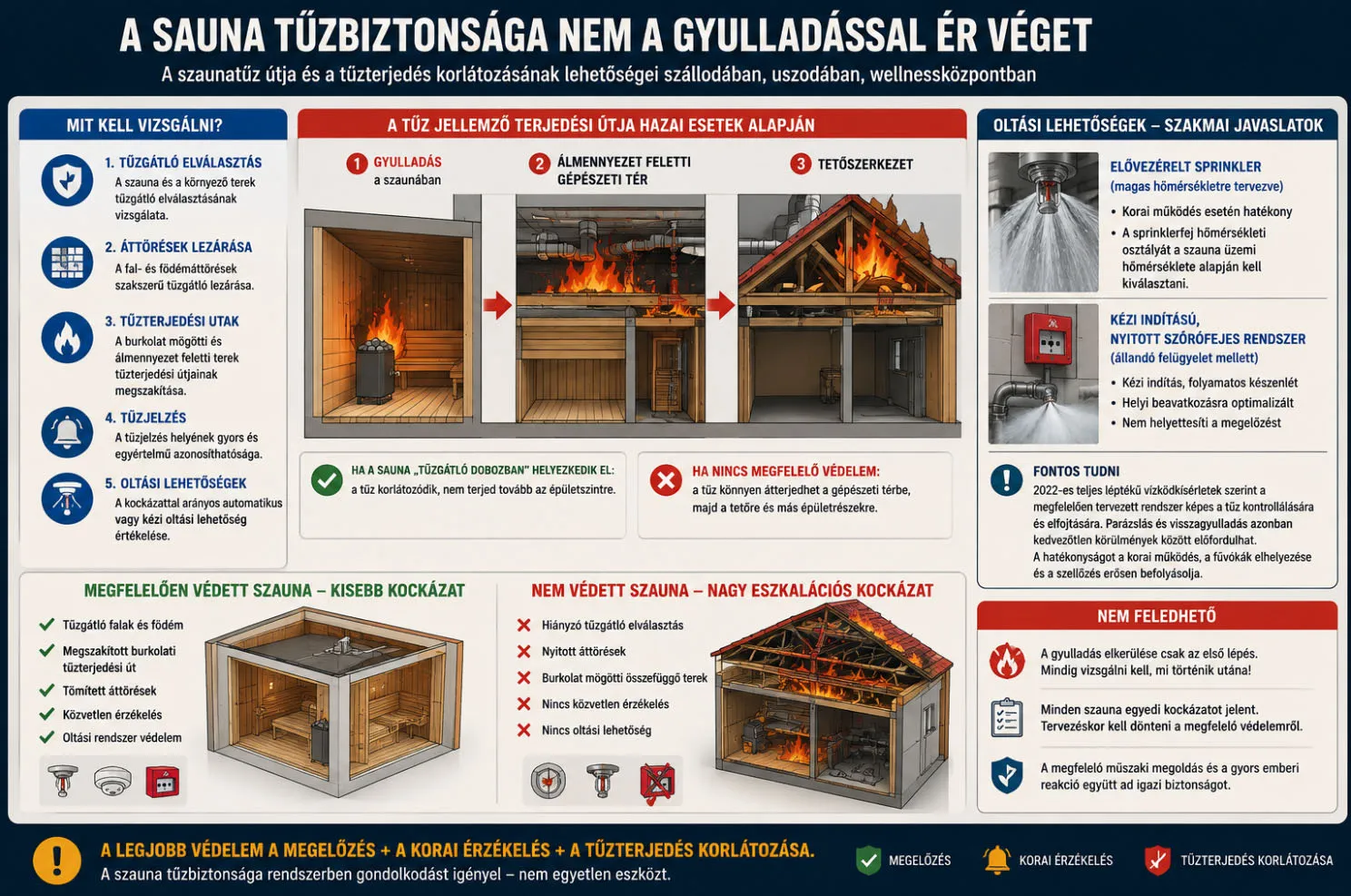
The importance of limiting fire spread (AI graphic)
The Hungarian regulatory framework
The National Fire Safety Code in force does not contain a separate chapter addressed to saunas. It does not follow that the sauna falls outside the fire safety requirements. The general provisions of the National Fire Safety Code must be applied in the design, arrangement and use of the building.
The specific system of requirements can be established by examining several provisions together:
- the National Fire Safety Code and the fire safety requirements arising from the purpose of the building;
- the electrical installation and safety standards, and the Electrical Safety Code;
- the product requirements for the heater and the control;
- the manufacturer’s installation and operating instructions;
- the design documentation of the fire alarm system and of the extinguishing equipment;
- the fire safety regulations, the fire emergency plan and the arrangements for training;
- the design solutions determined on the basis of the risk of the given facility.
The fire emergency plan has a prominent role here. In commercial accommodation with more than 20 beds, where a fire emergency plan is mandatory, the plan must be supplemented with a specific fire protocol for the sauna. It must record what an alarm from the sauna zone means, who goes to check, who starts the evacuation, who calls 112 and when, how the heater is safely switched off, which door must be kept closed, and when any attempt at extinguishing by staff is already forbidden.
From the Hungarian case series, a single organisational measure stands out. In the case of a signal pointing to a real fire, calling 112 should not depend on a management approval chain. Because within a few tens of minutes the initial sauna fire becomes a roof fire - and by then it is all the same.
For wood-fired saunas, there is in addition the compatibility of the heater, the flue and the chimney, the design of roof and floor penetrations, regular cleaning against soot deposits, and the safety clearances related to these.
Operator’s checklist
Most sauna fires do not arise from ignorance of the rule. The cause is typically that no routine enforced the rule over the long term. In hotel and wellness environments it is therefore recommended to introduce a one-page sauna fire safety checklist.
Before starting, every time
- There is nothing on the heater, on the guard rail, or near them.
- The sauna contains no foreign objects, textiles, cleaning equipment or decorations.
- There is no visible discolouration, charring, damaged cable or loosened lining.
- The heater stones are in order, not crumbling and not settled.
During operation
- A round every shift to check for smell, smoke, abnormal noise and an overheating switch.
- In case of anything abnormal, switching off the heater, if it can be done safely.
- In case of fire, raising the alarm immediately, identifying the location of the fire, calling 112 and keeping the doors closed.
At closing
- Switching off the heater, clearing the sauna of objects, and a closing inspection.
- Documenting the daily check.
Periodically
- Rearranging and replacing the heater stones according to the manufacturer’s instructions.
- At least once a year, a targeted sauna electrical inspection of the joints, the control, the lighting and the heat-resistant cabling.
- Electrical safety inspection according to the legal cycle.
- Testing the fire alarm and practising the protocol linked to the sauna-zone alarm with the staff.
- Checking the hidden fire-spread paths and the fire-resisting seals.
The most important rule of the list is the following: a faulty sauna must be taken out of operation, instead of being observed.
Summary
The fire safety of a sauna can be made up of elements of a protective chain building on each other:
suitable product → proper installation → safe use → regular maintenance → early detection → immediate action → limiting fire spread.
If any element is missing, the effectiveness of the others also decreases. A properly installed heater is not enough if a combustible object is placed on it. A good fire alarm system is not enough if the signal is not followed by action for twenty minutes. A quick fire service response does not prevent roof damage if the fire spreads unhindered in the hidden space above the sauna.
As a designer, I draw the conclusion from this that a hotel, swimming pool or communal sauna must be treated with at least the same weight as a boiler room or a commercial kitchen extraction system. It is a stand-alone technological unit with a high local fire risk, with its own detection, its own maintenance regime, its own fire-containment requirements and its own intervention protocol.
When did you last check whether the manufacturer’s prescribed clearance around the heater is in place in the sauna of your own facility, what state the electrical system is in, or whether there is any fire detector at all?