
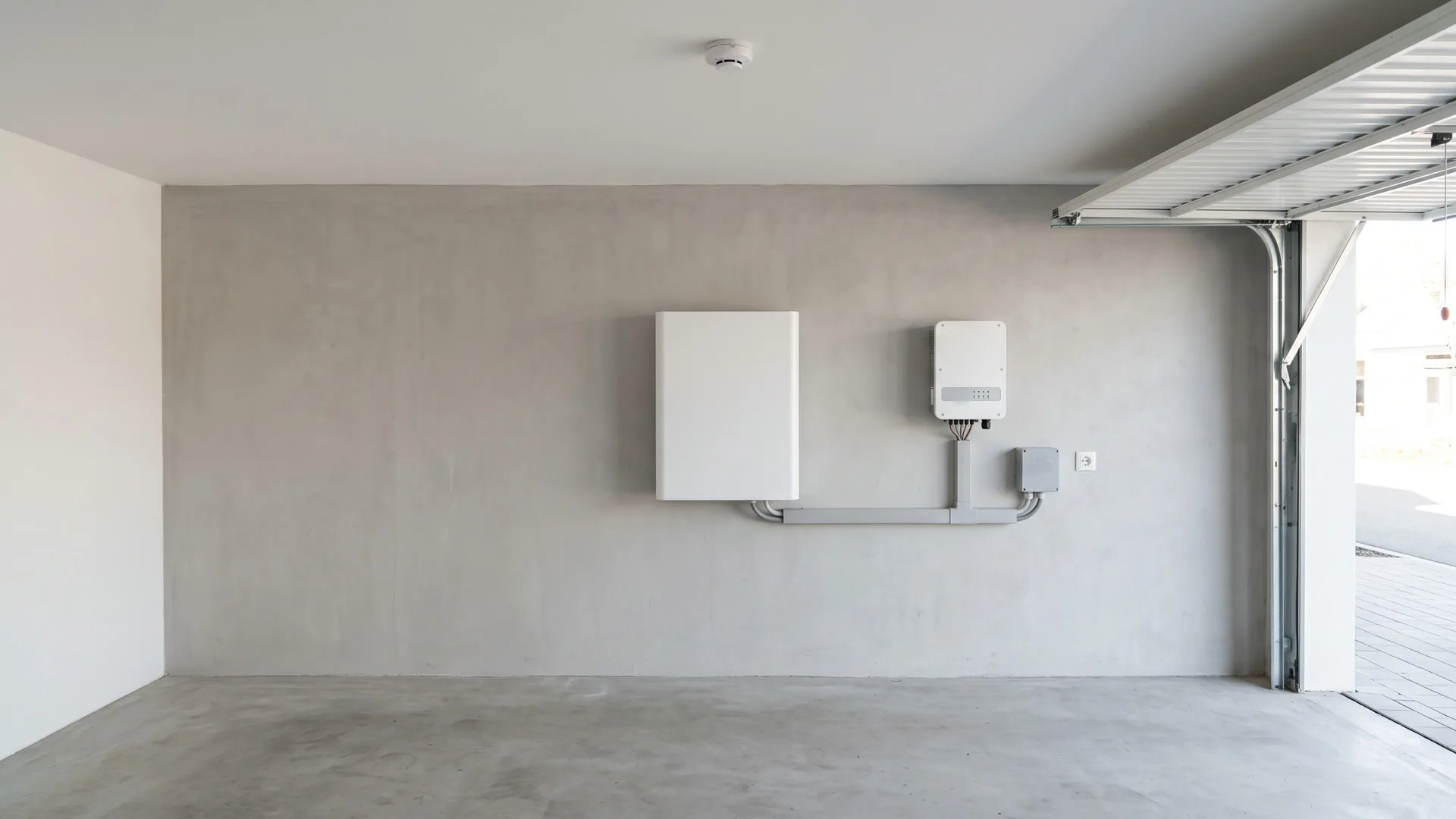
In brief: the location of a home lithium-ion battery energy storage system should be chosen on fire safety grounds, not on the principle of “wherever it fits”. Annex 6T of TvMI 1.7 gives a recommendation for stationary systems above 5 kWh: in a residential building of at most 2 storeys or at most 2 flats, up to 20 kWh, the recommended locations are a garage, a plant room, a storage room, a pantry or outdoors, while a bedroom, a children’s room or an attic space should be avoided. The general rules of the OTSZ are mandatory for energy storage systems as well.
Legal basis: Decree 54/2014. (XII. 5.) BM rendelet (OTSZ), Sections 87(1)-(3) and 200(1); Act XXXI of 1996, Section 3/A(3). Recommendation: TvMI 1.7:2025.02.01., Annex 6T.
More and more solar systems are being fitted with a battery, so that the electricity generated during the day can also be used in the evening. A lithium-ion battery energy storage system (BESS for short) is a useful device, but from a fire safety point of view it matters where it is installed. If a cell fails, thermal runaway can cause the battery to release a great deal of heat and dense, toxic and flammable gases. For this reason its location should not be chosen on the principle of “wherever it fits”.
What do international professional organisations say?
According to a summary published on 9 November by the US-based UL Standards & Engagement, home battery energy storage systems are becoming more widespread, but a significant share of owners are not aware of the risks of lithium-ion batteries and do not know what to do if something goes wrong. The organisation recommends deliberate installation and a smoke detector nearby. An analysis by the French Efectis, dated 10 November, deals with larger office and industrial battery rooms. It warns that in lithium-ion battery fires toxic smoke, a directed jet flame and the explosion hazard of accumulated gases occur together, so the location must be considered at the start of design, not at commissioning.
The lesson applies in Hungary too: the safety of a battery depends largely on its location and the quality of the installation.
What is mandatory, and what is a recommendation?
Mandatory: the general rules of the OTSZ. The National Fire Protection Regulation (OTSZ, Decree of the Minister of the Interior 54/2014. (XII. 5.) BM rendelet, hereafter the OTSZ) contains no separate chapter on battery energy storage systems. Its general rules do apply to them, however:
- Only electrical equipment may be used that, when used as intended, does not pose an ignition hazard to its surroundings (OTSZ Section 200(1)).
- If the battery is part of a solar system, a remotely operated electrical and a manual fire-emergency disconnection option must be provided on the DC side near the solar modules, and the switch must be placed near the building’s electrical main fire switch, with a sign (OTSZ Section 87(1)-(3)).
Recommendation: TvMI 1.7. Detailed solutions are given in Annex 6T of the Fire Protection Technical Guideline (TvMI) on protection against fire spread (TvMI 1.7:2025.02.01.), published by the Hungarian National Directorate General for Disaster Management (BM OKF). Applying a TvMI is voluntary, but if a solution complies with it, the safety level required by the OTSZ is presumed to be achieved. A deviation is possible if the designer demonstrates the same level of safety (Act XXXI of 1996, Section 3/A(3)). The annex applies to stationary lithium-ion energy storage systems above 5 kWh that are connected to the electrical grid.
Basic conditions in every building
According to the TvMI, a few basic conditions must be met in every case (Annex 6T, clauses T.1.1-T.1.6):
- the battery and the charge-discharge unit (inverter) are compatible with each other, and the connected electrical network complies with the electrical requirements;
- there is a monitoring unit (battery management system, BMS) that automatically interrupts charging and disconnects the consumers in the event of abnormal operation;
- the fire-emergency disconnection complies with the requirements of the TvMI on electrical equipment, lightning protection and protection against electrostatic charging;
- a warning sign or safety symbol at the main entrance of the building and on the energy storage system itself indicates the system. Firefighters need to know that the cables may remain live after disconnection;
- the installation follows the manufacturer’s instructions, with a factory-made, certified product or a system assembled from certified components.
Family house: where can a system of up to 20 kWh go?
Most family houses have a system between 5 and 20 kWh. For this case (a residential building of at most 2 storeys or at most 2 flats, Annex 6T, clause T.1.7.1) the TvMI recommends the following.
Inside the building:
- The battery should not obstruct escape, that is, it should not be on the route leading to the exit or next to the exit.
- It should primarily not be placed in a living space. The bedroom, the living room, the hall, the kitchen, the dining room and the bathroom all count as living spaces. It should under no circumstances be placed in a bedroom or a children’s room. If it is nevertheless placed in a living space, the system should comply with the MSZ EN IEC 62619 safety standard.
- The recommended location is a garage, a plant room, a storage room, a pantry or outdoors.
- If the system does not comply with MSZ EN IEC 62619, the walls and floor of the room should have a fire resistance of (R)EI 30, and its door opening to the living space should have a fire resistance of EI2 30-C.
- It should not be placed in an attic space (an unfinished roof space).
- The operating temperature prescribed by the manufacturer should be maintainable. Solutions can be built-in temperature protection, a room large enough relative to the system, or dimensioned ventilation or cooling.
- There should be fire detection in the room. This can be a fixed fire alarm system or a device that is easy to supervise, such as a smart (Wi-Fi-connected) smoke alarm or a smoke detector connected to the intruder (security) alarm system. The person responsible for maintenance should be recorded in writing.
On the façade:
- The system should be fixed to a wall with a fire resistance of at least EI 30.
- The distance from a door, a window and a combustible building element should be at least 1 metre if the system complies with MSZ EN IEC 62619, and at least 2 metres if it does not.
- Combustible façade insulation (reaction-to-fire class B-E) counts here as well. On a wall with polystyrene insulation, the “just screw it on next to the garage” solution is therefore typically not appropriate according to the TvMI. If the distance cannot be kept, a fire-spread barrier or a fire-resisting cabinet rated for lithium-ion battery fires with at least 30 minutes of resistance is the solution.
In the yard, further from the building:
- For a system complying with MSZ EN IEC 62619, the distance from the openings and combustible structures of the building itself and from outdoor storage of combustible material should be at least 1 metre, and from a building on the neighbouring plot at least 2 metres. If the system does not comply with the standard, these distances are 2 and 3 metres.
- The distance can be reduced by a protective wall of at least EI 30 and reaction-to-fire class A1 that extends at least 0.5 metres beyond the size of the system in the direction to be protected.
If the system is larger than 20 kWh
For larger systems the TvMI is stricter (Annex 6T, clause T.1.7.2). Up to 100 kWh, with a system complying with MSZ EN IEC 62619, a garage, a plant room or a storage room is still acceptable, with (R)EI 30 walls and floor and an EI2 30-C door. If the system does not comply with the standard, or exceeds 100 kWh, a separate battery room with fire-resisting constructions is needed. Above 100 kWh the TvMI also recommends a fixed fire alarm system and a fixed fire extinguishing system.
Apartment buildings, offices, community buildings
In residential buildings with more than two storeys and more than two flats, and in buildings for community use (offices, schools, hotels, shops), the TvMI sets separate, stricter conditions (Annex 6T, clauses T.1.8 and T.1.9). Here the location of the energy storage system typically has to be designed together with fire compartmentation, escape routes and a fixed fire alarm system. In such cases it is worth involving the fire safety designer at the concept stage. For further considerations on apartment buildings, see our page on residential building fire safety.
Another annex of TvMI 1.7, Annex 6S, deals with charging micromobility devices. We wrote about it in our article on charging e-scooters and e-bikes.
Practical checklist before installation
- What is the total capacity of the system (kWh), and does it comply with MSZ EN IEC 62619? Ask for the manufacturer’s documentation and the certificate.
- Where will the system go: in a garage, a plant room, a pantry, on the façade or in the yard? Not on an escape route, not in a bedroom, not in the attic space?
- For a façade location, is the required distance kept from windows, doors and combustible façade insulation?
- Is there a smoke detector in the room, and who is responsible for its maintenance?
- Is the fire-emergency disconnection in place, and are the warning signs at the main entrance and on the system?
Frequently asked questions
Is it mandatory to follow TvMI 1.7?
Applying the TvMI is voluntary. If a solution complies with it, the safety level required by the OTSZ is presumed to be achieved. A deviation is possible if the designer demonstrates the same level of safety (Act XXXI of 1996, Section 3/A(3)).
Can I install the battery in a bedroom or a children’s room?
According to the TvMI, it should under no circumstances be placed in a bedroom or a children’s room. It should primarily not be placed in a living space, and if it is nevertheless placed there, the system should comply with the MSZ EN IEC 62619 safety standard.
Can I install it on the exterior wall next to the garage?
The TvMI recommends fixing the system to a wall with a fire resistance of at least EI 30, and keeping a distance of at least 1 metre from doors, windows and combustible building elements if the system complies with MSZ EN IEC 62619, and at least 2 metres otherwise. Combustible façade insulation (reaction-to-fire class B-E) counts here as well. On a wall with polystyrene insulation this typically is not met; in that case a fire-spread barrier or a fire-resisting cabinet rated for lithium-ion battery fires with at least 30 minutes of resistance is the solution.
How can Fireeng help?
If a new solar system with a battery is being designed, or an energy storage system is going into an existing building, Fireeng Kft., as a fire safety designer and expert, helps to decide where and how the system can be placed so that it complies with the recommendations of the TvMI, or so that the equivalence of a different solution can be demonstrated. In apartment buildings, office buildings and community buildings we also prepare the fire safety design of the energy storage system as part of the fire safety design chapter. Our article on commissioning the fire safety design chapter gives a list of the data needed to prepare an order. Details can be found on our fire safety design page, and you can request a quote here.